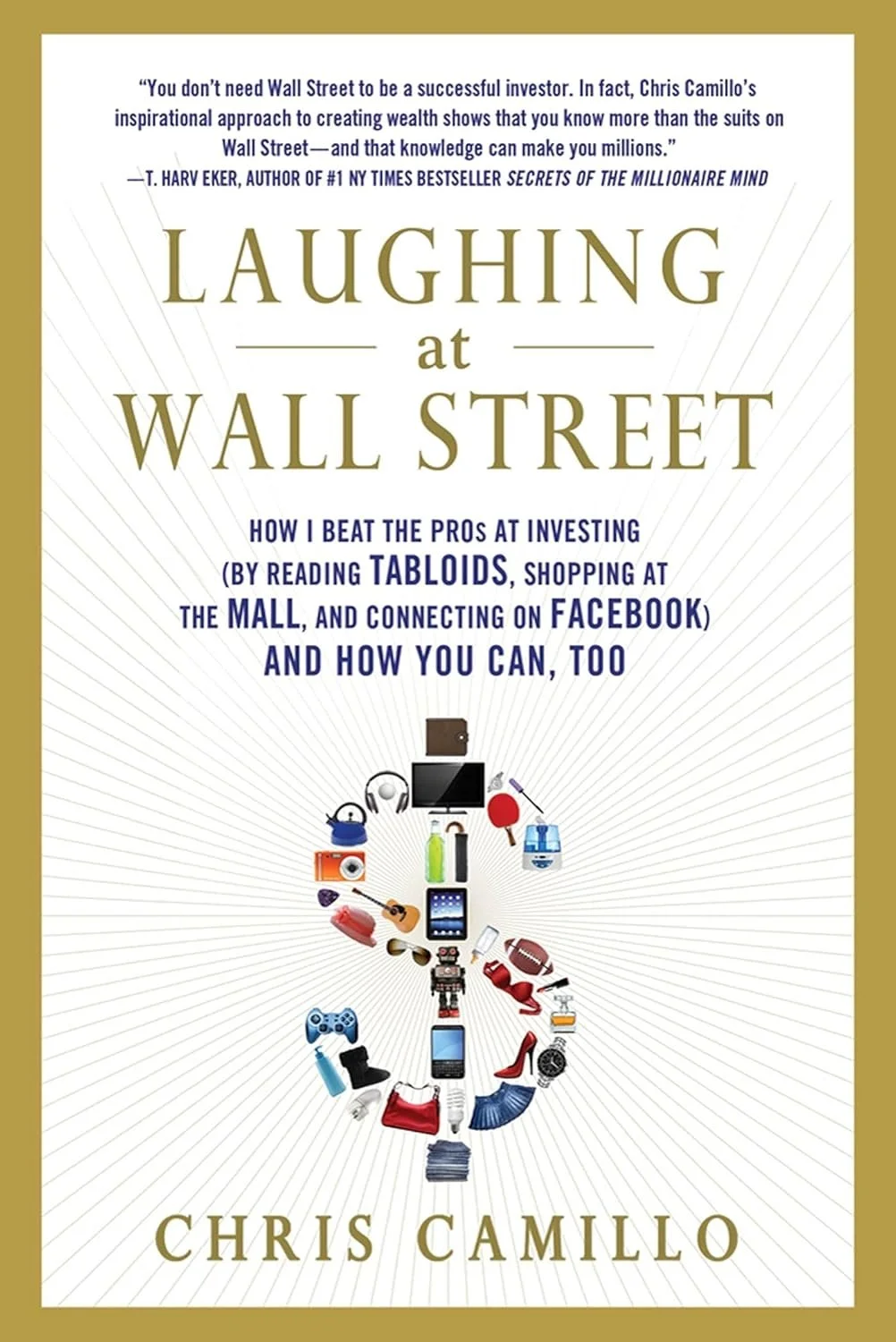
“Laughing at Wall Street: How I Beat the Pros at Investing (by Reading Tabloids, Shopping at the Mall, and Connecting on Facebook) and How You Can, Too” by Chris Camillo
Date Finished: Jan 27, 2026
Pages: 240
How strongly I recommend it: 6/10
Published in October 30, 2012 by St. Martin's Griffin
Find it at Amazon
I heard an interview with Chris Camillo which made me interested in his methods. I struggle with the idea that individuals are able to see individual stock market buys that Wall Street doesn’t. Read through the notes and decide for yourself.
My Notes:
A decade later I would relearn this lesson while studying the “efficient markets theory” in business school. The theory asserts that it is not possible for a person to achieve investment returns greater than average market returns, given the information publicly available at the time of the investment. Pg 2
But on Wall Street, two long-established methodologies drive nearly 100 percent of all investment decisions:
1. Technical analysis: then study of past market data to forecast the future direction of stock price; and
2. Fundamental analysis: the study of the health, financial statements, market, management, and competitors of a company to determine the company’s stock value. Pg 9
The legendary self-made billionaire and investor Warren Buffett has said, “I realized technical analysis didn’t work when I turned the charts upside down and didn’t get a different answer.” Pg 10
Once investors began to observe this trend, it disappeared as quickly as it had emerged, because investors sought to purchase stocks ahead of the expected January rise, giving birth to a new phenomenon of buying in the month of December known as the annual “Santa Claus rally.” Not surprisingly, as investors chased the Santa Claus rally, it began to appear earlier and earlier in the month, until it, too, evaporated. Pg 11
FUNDAMENTAL ANALYSIS
One Person’s Trash is Another Person’s Treasure
Fundamental analysis involves studying all elements of a company and its financials in order to determine its market value. Pg 14
Unlike technical analysis, which uses historical price patterns to predict future price movement, fundamental analysis seeks to find companies with stock prices that are unjustifiably low, based on what is determined to be the company’s “true” value. Pg 17
It is not investment analysis, but the art of uncovering game-changing information before others do that is the true Holy Grail of investing. Pg 20
In a financial industry that is richly rewarded for mediocrity, there is simply not enough financial incentive for them to leave their comfort zone. And that is great news for us Wall Street outsiders. Pg 21
Even the age-old perception that professional money managers are able to preserve wealth through bad economic times has proven to be nothing more than a sham. “The belief that bear [downward trending] strongly favor active [professional] management is a myth,” says Srikant Dash, global head of research and design at Standard & Poor’s. “A majority of active funds regardless of fund type (aggressive, growth, value, income, etc.) were outperformed by indices during the down markets of 2008.” Pg 26
One of the most famous of the early tycoons, J.P. Morgan, is known to have financed the purchase of antiquated rifles being sold by the U.S. Army for $3.50 each. Morgan’s partner re-machined the rifles and sold them back to the army for $33.00 each. The guns were later found to be defective, at times blowing the thumbs off the men who used them. Pg 28
The problem with “soft” expense fees is that they are not separated out for you on your account statements. Unless you do the math, you have no way of knowing how much you are actually paying. Pg 33
In testimony to Congress, former senator Peter G. Fitzgerald (R.Ill.), chairman of the Senate Subcommittee on Financial Management, referred to the $7 trillion U.S. mutual fund industry as “the world’s largest skimming operation.” A politician may never have spoken truer words. Pg 34
It didn’t take me long to grasp what little value the firm placed on stock picking. Above all, we were a sales and marketing organization.
We interns and sales trainees developed warm leads for the brokers. The brokers turned those warm leads into new client accounts for their branch offices. Pg 36
For investors, the hard-wired human aversion to losing money presents a considerable psychological barrier to overcome, because the sole path to successful investing, regardless of one’s methods or beliefs, is to risk loss. The Russians have a saying: “He who doesn’t risk never gets to drink champagne.” The problem is that most people don’t believe they can afford to take on financial risk. Pg 40
By now, it should be clear that Wall Street’s vulnerability, its Achilles’ heel to be exploited, is its utter inability to quickly uncover emerging game-changing information—information with the potential to materially impact sales and profits. Pg 64-65
I call the science of initiating investments upon discovery of an information imbalance, and exiting investments at the point of information parity, “information arbitrage.” Pg 69
Your job is to read each and every publication analyst report, news story, and financial blog dating back six months that pertains to the company for which you have developed your game-changing hypothesis. Pg 113
The moment the recomputed consensus score climbs above 2 (signifying information parity), I know to exit my position in the investment. Pg
How will you know when this is the case? Here’s a rule of thumb I use: if the number of shares you are planning to buy or sell, when multiplied by one thousand, equals a number that is larger than your stock’s “average daily trading volume” (listed on your stock’s Yahoo! Finance quote page as AvgVol), you might consider placing a limit order. Pg 152
As an information arbitrage investor. I get (at most) one to two opportunities over the course of any given year to pursue well-founded investments based on game-changing information imbalances… I nearly always favor buying stock option contracts over shares of stock alone. Pg 165
For this reason, I generally purchase option contracts with expiration dates ranging from six to nine months away. Since publicly traded companies are required to announce sales and earnings every three months, the sic-to-nine-month window ensures ample opportunity for the anticipated dissemination of game-changing information to the market. Pg 167
Option contracts, which represent one hundred shares of stock, are quoted on a “per-share” basis, so you must multiply the quoted option price by one hundred to determine the actual price to purchase or sell the contract. Pg 169
The larger the stock price increase, the more you benefit financially from owning call stock options contracts versus shares of a company’s stock. The larger the stock price decline, the more you are financially penalized owning call stock option contracts versus shares of the company’s stock. Pg 172
Whereas a call opt9ion provides the owner with the right (but not the obligation) to purchase a specific number of shares of a stock at a predetermined price and within a certain period of time, a put option contract provides the owner with the right to(but not the opbligation) to sell a specific number of shares of a stock at a predetermined price and within a certain period of time.
Put option contracts are often purchased as a form of short-term insurance by investors seeking to limit the potential losses on stocks they already own. Pg 173
A put option contract provides you with the legal right (but not the obligation) to sell at a predetermined price.
A put option contract with a strike price that is greater than the company’s current stock price (“in the money”) already has intrinsic value, provides a small to reasonably large amount of leverage, and will expire worthless only if the stock price rises above the contract’s strike price. Pg 174-175
When purchasing put option contracts, I generally seek out the lowest available strike price that is equal to or greater than the current stock price of the company in which I am seeking to invest. Pg 175
Here’s what you should do:
* Exploit Wall Street’s vulnerability. Focus your efforts on products, companies, and trends (female, youth, low-income, rural) viewed as foreign to Wall Street’s core demographic of middle-aged, affluent men who work and reside in major metropolitan areas.
* Believe what you see, no what financial pundits and those on Wall Street tell you to believe.
* Research your investment observations with the vigor and rigidity of a scientist seeking to submit a breakthrough discovery to a prestigious scientific journal—pursuing only game-changing investment observations that are not yet widely known or accepted as fact by Wall Street.
* Institute the 100x money multiplier across every area of your life to unveil new sources of Other People’s Money for funding your Big Money account.
* Let the concept of Big Money investing with Other People’s Money empower you to act on the investment opportunities you uncover, and use stock option contracts to maximize the potential return for each of your investment dollars.
* Sell your investments the second the game-changing information become common knowledge—whether that be at a profit or a loss.
* Start small, but start now. Keep in mind that I started with just $300!
* Above all, remember that you are not alone. Exponentially increase your observational and due diligence resources by leveraging each and every person in your daily life, and those you are able to connect with through social media, business networking, and online investment communities. Pg 182
You can’t chase the Next Big Thing, but by being astutely observant, you can be sure to recognize the Next Big Thing before those on Wall Street do. And when you do, you know exactly what to do, how to do it, and when! Pg 183
For more… find it at Amazon.